
“Once electronics were small enough to be used in almost all industries, their effect on productivity vanished.” – Pablo Azar
This article summarizes the main points from Azar’s 2022 paper of ‘Moore’s Law and Economic Growth’ . Azar uses his novel dataset to study the how the size of semiconductor impact GDP growth.
The global labor productivity growth has been slowed. World Bank published a collection of reports about global productivity. Both advanced economies and emerging/developing economies experienced the slowdown in productivity post-GFC. The current level of global productivity growth is close to the level around early 2000s.

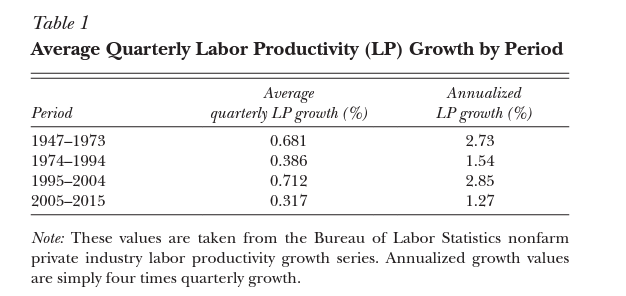
The productivity slowdown is a global issue, but Azar’s work specifically looked at the productivity growth in the US. The US average productivity growth in the 2005-2015 periods is significantly lower than the average for the period of 1995-2004. Syverson (2017) calculated this in his study. The US labor productivity growth rate dropped from 2.85% in the 1995-2004 period to 1.27% in the 2005-2015 period. And the slowdown does not just happen in the US, other OECD countries also experience the same trend in the recent period.
In considering what caused the trend in productivity growth, Azar (2022) attempt to use Moore’s Law to explain the dynamics of the productivity growth. Moore’s Law is firstly an observation made in 1965 by Gordon Moore, who is the co-founder of Intel. Moore initially forecast the number of components on an integrated circuit would double every year until it reached 65,000 by 1975. His forecast was correct in 1975, then he predicted that the number of transistors on a chip would double every two years. And the prediction becomes the famous Moore’s Law.
As size of transistors becomes smaller and smaller, transistors are small enough to be installed on almost anything. Azar noticed the trend of decreasing in size and weight for computers, he developed a new model to assess how this impacts on productivity growth.
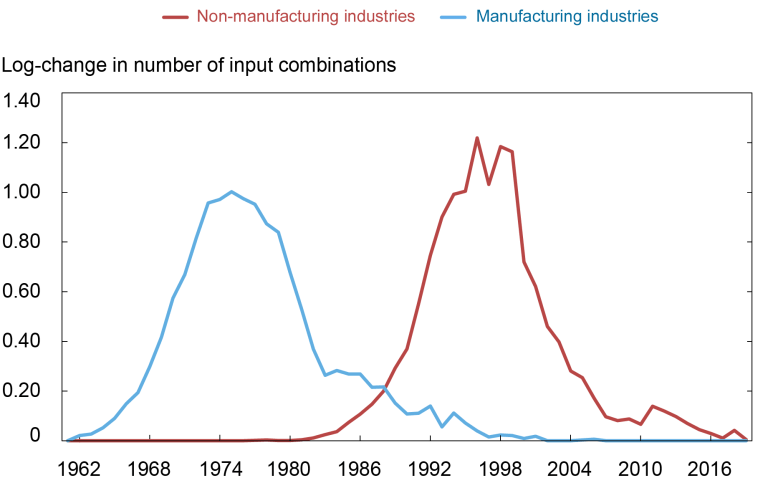
Based on his model, there are number of new combinations for inputs due to adoption of new inputs. The different peaks is a results of the adoption of computers and electronics in different industries. Manufacturing industries were early adopters while non-manufacturing industries adopt when personal computers were introduced.
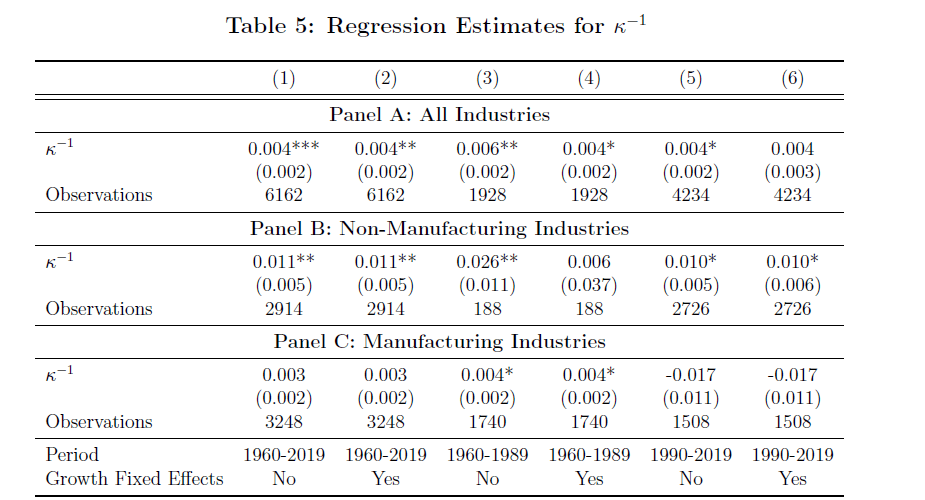
The reduced in size and weight for electronics and computers lead to increased number of input combinations. By regulating his model, Azar provided support to the reduced size caused increased number of input combinations. He regressed industry-level productivity on the number of feasible input combinations as a result of electronic miniaturization. The 1% increase in the possible input combinations leading to a 0.004% increase in all industries productivity while for non-manufacturing the number is even higher.
To get the impact of Moore’s Law on the overall US economy, Azar (2022) compute the lower bound of the change in log total factor productivity given the change in growth productivity.

Based on Azar’s estimate from his model, 11.74% of all productivity growth can be attributed to Moore’s Law (or miniaturaztion of electronics) in 1960-2019 period. An even higher attribution can be estimated by using a different functional form (Cobb-Douglas specification) in the production functions.
From his estimation for different periods, the Moore’s Law contributed 14.22% for all productivity growth in the 1985-2005. In the mid-2000s, the contribution from Moore’s Law was vanished and so the all productivity growths declined. An observation by him is that the computers had becomes small enough, and it became essential for almost every industry post-2005. Any subsequent adoption after this period has provided small improvements in productivity. So his conclusion is that a large part of the post-2005 productivity slowdown can be explained by the saturation of electronics adoption.
Reference:
Azar, Pablo 2022, “Computer Saturation and the Productivity Slowdown,” Federal Reserve Bank of New York Liberty Street Economics, October 6, 2022, https://libertystreeteconomics.newyorkfed.org/2022/10/computer-saturation-and-the-productivity-slowdown/.
Dieppe, Alistair. 2021. Global Productivity : Trends, Drivers, and Policies. Washington, DC: World Bank. © World Bank. https://openknowledge.worldbank.org/handle/10986/34015 License: CC BY 3.0 IGO.
Rotman, David. 2020. We’re Not Prepared for the End of Moore’s Law. https://www.technologyreview.com/2020/02/24/905789/were-not-prepared-for-the-end-of-moores-law/
Syverson, Chad. 2017. “Challenges to Mismeasurement Explanations for the US Productivity Slowdown.” Journal of Economic Perspectives, 31 (2): 165-86.
 Eddy Zhang